
Every employee may reach a stage where they need more than a few days off. For long-term personal or professional goals, companies offer what is called a sabbatical leave. It goes beyond casual or earned leave and gives the employee time away from work with the assurance of returning to the same role.
The sabbatical leave definition is simple: it is an extended leave of absence granted by the employer, either paid or unpaid. The duration and conditions usually depend on the organisation’s sabbatical leave policy.
What is sabbatical leave used for? Employees commonly take it to pursue higher education, research, travel, family commitments, or even to recover from work-related stress. Companies see it as a way to retain talent and support long-term employee well-being.
In this blog, we break down the sabbatical leave meaning, policy features, eligibility criteria, and application format. You will also find sample letters that can be customised when applying for your own sabbatical.
Related: How to Write a Leave Application for Office [Format, Samples]
Sabbatical Leave Meaning & Definition
The term sabbatical leave comes from the idea of taking time off to rest or pursue learning. In the workplace, it refers to a longer break from duties that still protects your employment. Unlike a resignation, sabbatical leave ensures you return to the same or an equivalent role after your absence.
Sabbatical leave definition: an extended leave of absence approved by the employer, either paid or unpaid, that allows employees to focus on personal or professional goals. The duration may range from a few weeks to several months, depending on company policy.
This type of leave is different from casual, sick, or annual leave. It is planned in advance, comes with eligibility conditions, and is often linked to years of service. Many organisations include it in their sabbatical leave policy as part of employee benefits.
Here’s a simple comparison to understand how sabbatical leave stands apart from other leave types:
| Type of Leave | Duration | Job Security | Purpose |
|---|---|---|---|
| Sabbatical Leave | Months to a year (depending on policy) | Yes, position reserved | Education, projects, travel, family, recovery |
| Annual Leave | Few days to weeks | Yes | Rest, personal tasks, short travel |
| Unpaid Leave | Short to medium duration | Varies by employer | Personal reasons not covered under policy |
In short, sabbatical leave is a structured break that supports both personal development and long-term employee retention. Companies that provide this option often see improved loyalty and productivity when employees return refreshed and motivated.
Also Read:
| One Day Leave Application for Office | 3 Days Leave Application for Office |
| 2 Days Leave Application for Office | 4 Days Leave Application for Office |
Key Aspects of Sabbatical Leave
Sabbatical leave is a planned, extended break from work that helps employees grow personally or professionally without losing their job. Below is a simple, reader-friendly explanation of the key elements of sabbatical leave, written to match AI Overview style and optimized for SEO.
Purpose of Sabbatical Leave
The main purpose of sabbatical leave is to give employees time to focus on personal goals or career development. This can include pursuing higher education, conducting research, writing a book, traveling, learning new skills, or recovering from burnout. It allows employees to return refreshed, motivated, and more productive.
Duration of Sabbatical Leave
The duration of sabbatical leave is usually longer than regular vacation or personal leave. Depending on the company’s policy, a sabbatical leave may last anywhere from a few weeks to several months, and in some cases, up to one year.
Employment Status During Sabbatical Leave
During a sabbatical leave, employees are not terminated. They continue to remain on the company’s payroll records as active employees, even though they are temporarily not performing their regular job duties.
Compensation During Sabbatical Leave
Sabbatical leave compensation varies from one organization to another. Some companies offer paid sabbatical leave, others provide partially paid sabbatical leave, while many offer unpaid sabbatical leave. The payment terms are clearly outlined in the company’s sabbatical leave policy.
Eligibility for Sabbatical Leave
To apply for sabbatical leave, employees usually need to meet specific eligibility criteria. Most companies require a minimum tenure, such as completing several years of continuous service, before approving a sabbatical.
Sabbatical Leave Application Process
The sabbatical leave application process typically requires employees to submit a request well in advance. This advance notice allows the company to plan resources, manage workloads, and ensure smooth operations during the employee’s absence.
Overall, sabbatical leave benefits both employees and employers by promoting work-life balance, long-term employee retention, and professional growth.
Benefits of sabbatical leave
Sabbatical leave offers several advantages for employees, providing an extended break to recharge, pursue personal goals, and enhance overall well-being.
Advantages of Sabbatical Leave
- Provide extended time away from work without risking job loss, focus on personal interests and goals.
- Enables opportunity to gain higher certifications, learn new skills, which can boost professional growth.
- Creates space to focus on major life goals, creative work, or long-delayed personal plans.
- Allows quality time with family and friends, improving relationships and emotional wellness.
- Offers opportunities for social work or volunteering, or community service.
- Supports treatment or recovery from health issues, helping restore overall physical and mental wellness.
- Encourages travel and connection with nature, which can inspire growth.
- Reduce burnout and rejuvenate motivation, helping employees return refreshed and more engaged.
Why Do Employees Take Sabbatical Leave?
Employees request sabbatical leave for many different reasons. Some use it for career growth, while others see it as a much-needed pause for personal commitments. Unlike short leave types, sabbaticals are usually planned months in advance and require clear communication with the employer.
One of the most common reasons is higher education. Professionals may take a break to complete a master’s degree, attend specialised training, or engage in research. In such cases, a sabbatical leave policy becomes an enabler for skill development without losing job security.
Another reason is personal well-being. Long stretches of work often lead to fatigue and burnout. A structured break helps employees return refreshed, which benefits both the individual and the company. Some also use the time to pursue hobbies, travel, or spend extended time with family.
Here are some of the most common situations when employees apply for sabbatical leave:
- Pursuing higher education or professional certification
- Conducting research or writing a thesis
- Personal or family care responsibilities
- Health recovery and mental well-being
- Volunteering, social work, or community service
- Travel or personal projects that require extended time
In short, employees opt for sabbatical leave when short-term leave is not enough. By offering this option, organisations demonstrate flexibility and trust, which often leads to stronger employee engagement and loyalty.
Related: Joining Letter Format and Samples
Sabbatical Leave Policy: Key Inclusions
Not every company offers sabbatical leave, and the ones that do often set specific rules around it. A sabbatical leave policy lays out those rules clearly so that both the employee and the employer know what to expect. This avoids confusion and ensures fairness.
Policies vary, but the basic idea is the same everywhere: sabbatical leave is a planned privilege, not an automatic right. Companies usually link it to years of service, role requirements, and business needs. To give you a clearer picture, here are the points most HR teams include in their sabbatical leave guidelines:
- Eligibility: Employees often qualify only after completing a fixed number of years, usually between 3 to 5.
- Length of Leave: The break can be as short as three months or as long as a year, depending on the policy.
- Paid or Unpaid: Some organisations continue to pay a portion of the salary, while others treat it as unpaid leave with job protection.
- Reason for Leave: The purpose must be valid and shared upfront, such as higher education, research, or family care.
- Application Timeline: Advance notice is required — often two to three months before the intended start date.
- Approval Process: HR and reporting managers usually need to sign off before the leave is confirmed.
- Return Conditions: Some policies specify rejoining the same team, while others may allow a different but equivalent role.
Certain companies also include conditions like limiting how many employees can be on sabbatical at once, or asking for supporting documents if the leave is linked to education. These clauses help the organisation manage operations without blocking employee growth.
Overall, a transparent sabbatical leave policy benefits both sides. Employees gain the security to pursue personal goals, while companies retain experienced staff who return with renewed energy and commitment.
Related: How to Write a Job Application Email
How to Write a Sabbatical Leave Application [Format]
Requesting a sabbatical leave requires a formal and well-structured application. Since the leave period is longer than usual, the letter must clearly mention the reason, duration, and assurance of returning to work. A clear application helps your manager and HR make faster decisions.
Here is a simple step-by-step format you can follow while writing a sabbatical leave letter:
- Date: Mention the date when you are submitting the application.
- Recipient’s Details: Add your manager’s or HR’s name and designation.
- Subject Line: Keep it clear, e.g., “Application for Sabbatical Leave.”
- Introduction: State your intention to request sabbatical leave.
- Reason for Leave: Briefly explain the purpose (education, family, research, etc.).
- Duration: Specify the start and end dates of your sabbatical.
- Assurance: Confirm your commitment to return after the leave period.
- Contact Details: Share how you can be reached during your absence.
- Closing: End with gratitude and request for approval.
Here’s a ready-to-use sabbatical leave application format you can adapt to your needs:
To,
[Manager’s/HR’s Name]
[Designation]
[Company Name]
Subject: Application for Sabbatical Leave
Dear [Manager’s Name],
I would like to formally request a sabbatical leave from [start date] to [end date]. The reason for this request is [state reason – e.g., pursuing higher education, personal commitments, or research].
I assure you that I will return to my role after the sabbatical period and continue to contribute effectively. During my absence, I am happy to support in handing over responsibilities to ensure a smooth transition.
Kindly consider my request and grant approval.
Sincerely,
[Your Full Name]
[Employee ID/Department]
Also Read:
| 5 Days Leave Application for Office | Annual Leave Application Letter |
| 10 Days Leave Application for Office | Forced to forgo an optional leave? |
Sabbatical Leave Letter Samples
Once you know the sabbatical leave format, writing the actual letter becomes easier. Below are a few sample letters for different scenarios. You can adapt them depending on your purpose and company guidelines.
1. Sabbatical Leave Letter for Higher Education
Subject: Application for Sabbatical Leave for Higher Education
Dear [Manager’s Name],
I am writing to request a sabbatical leave from [start date] to [end date] in order to pursue my postgraduate studies in [course/program name]. This opportunity will help me enhance my skills and contribute more effectively upon my return.
I am committed to completing the handover process and ensuring a smooth transition before my departure. I kindly request your approval.
Sincerely,
[Your Full Name]
[Employee ID/Department]
2. Sabbatical Leave Letter for Family Reasons
Subject: Application for Sabbatical Leave for Family Responsibilities
Dear [Manager’s Name],
I would like to apply for a sabbatical leave starting from [start date] to [end date] to attend to urgent family responsibilities. I assure you that I will return to my duties after this period and continue contributing effectively.
I am willing to provide support in handing over my tasks before my leave begins. I request your approval for the same.
Sincerely,
[Your Full Name]
[Employee ID/Department]
3. Sabbatical Leave Letter for Health Recovery
Subject: Application for Sabbatical Leave for Health Reasons
Dear [Manager’s Name],
I would like to request a sabbatical leave from [start date] to [end date] due to medical reasons that require extended treatment and rest. I have attached the necessary medical documents for your reference.
I will ensure that all ongoing tasks are handed over before my leave begins. I kindly seek your approval for this request.
Sincerely,
[Your Full Name]
[Employee ID/Department]
These sabbatical leave samples cover common situations faced by employees. You can edit the dates, reason, and details to make them suitable for your own case.
Here is another sample sabbatical leave letter for your reference :
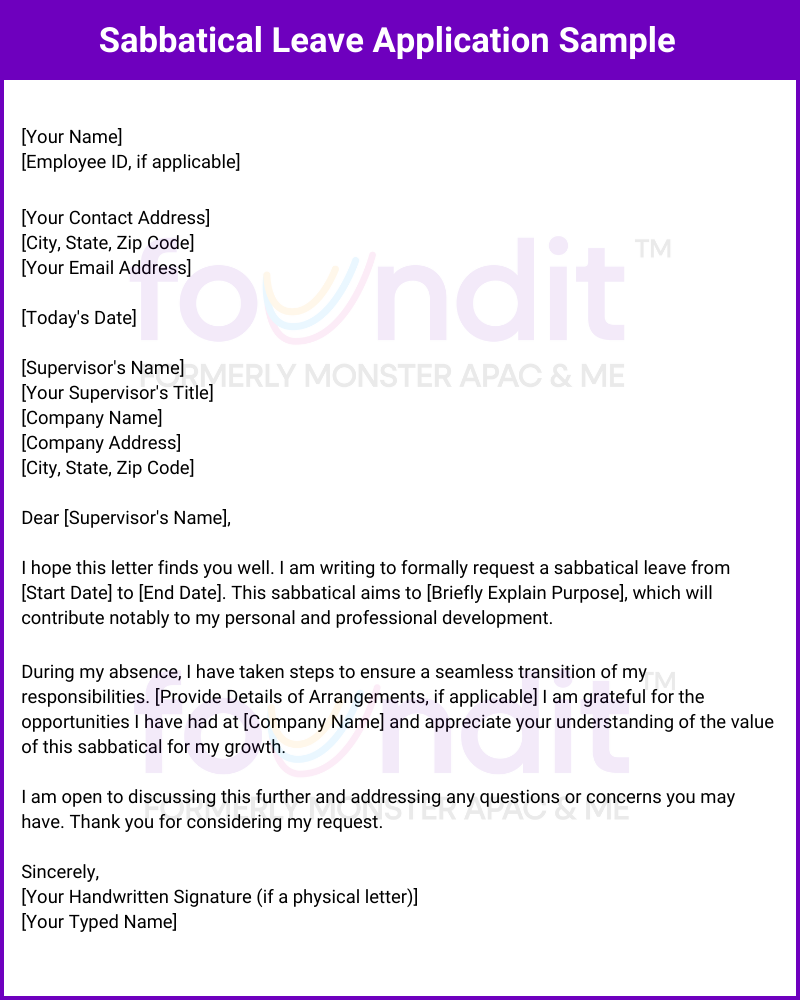
Sabbatical Leave Application Samples
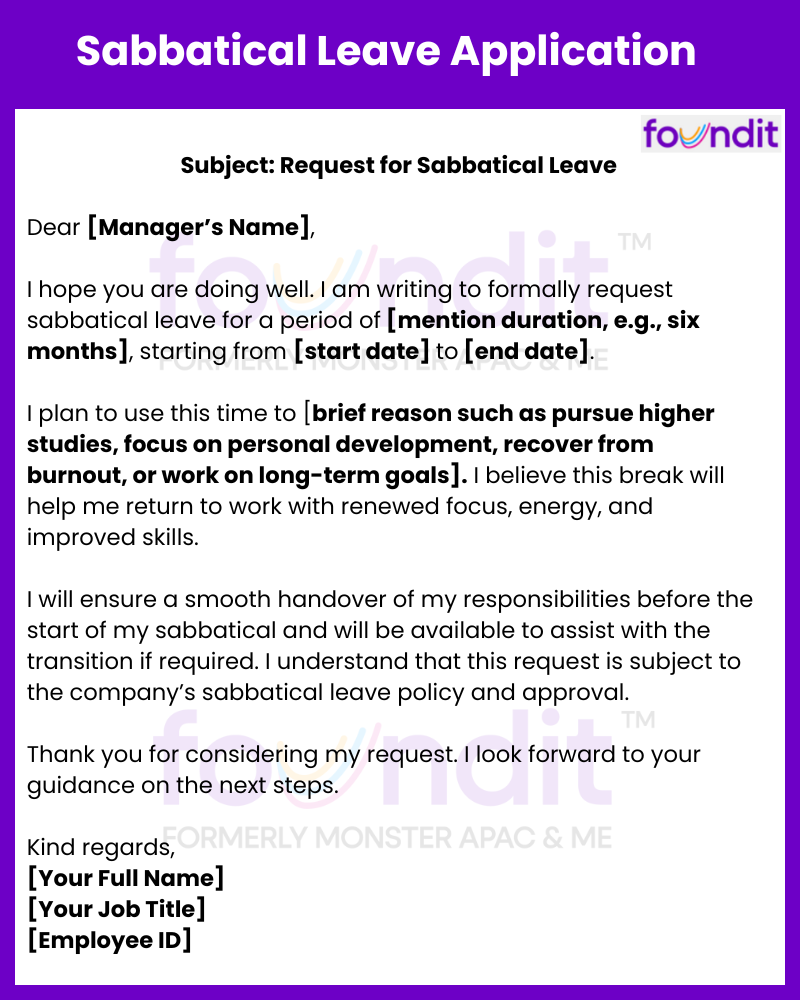
| Subject: Request for Sabbatical Leave Dear [Manager’s Name], I hope you are doing well. I am writing to formally request sabbatical leave for a period of [mention duration, e.g., six months], starting from [start date] to [end date]. I plan to use this time to [brief reason such as pursue higher studies, focus on personal development, recover from burnout, or work on long-term goals]. I believe this break will help me return to work with renewed focus, energy, and improved skills. I will ensure a smooth handover of my responsibilities before the start of my sabbatical and will be available to assist with the transition if required. I understand that this request is subject to the company’s sabbatical leave policy and approval. Thank you for considering my request. I look forward to your guidance on the next steps. Kind regards, [Your Full Name] [Your Job Title] [Employee ID] |
Pros and Cons of Sabbatical Leave
Like any workplace policy, sabbatical leave has both advantages and drawbacks. For employees, it can be life-changing, but for organisations, it requires planning and flexibility. Understanding both sides will help you decide whether taking or offering sabbatical leave makes sense.
Here is a simple overview of the pros and cons of sabbatical leave:
| Pros | Cons |
|---|---|
| Gives employees time for higher studies, research, or personal projects | Extended absence may disrupt workflow or team balance |
| Helps reduce burnout and improve long-term productivity | Not all roles can easily be covered during long absences |
| Strengthens employee loyalty and retention | May be unpaid, leading to financial stress for employees |
| Improves employer branding as a people-friendly organisation | Needs careful workforce planning to avoid gaps in projects |
| Allows employees to return with new skills and fresh perspective | Some staff may struggle to re-adjust after a long break |
For employees, the key benefit is having uninterrupted time to focus on long-term goals while keeping their job secure. For companies, offering sabbatical leave can boost retention and create a positive work culture. The challenge lies in managing operations smoothly while staff are away.
Conclusion
Sabbatical leave is a planned career break that allows employees to take extended time off while keeping their job secure. It is commonly used for higher studies, personal development, health recovery, travel, or skill building. Before applying, employees should check their company’s sabbatical leave policy and submit a formal sabbatical leave application. When used properly, a sabbatical leave helps employees return to work refreshed, focused, and more productive, benefiting both the individual and the employer.
Sabbatical Leave Application FAQs
🔽 What is the difference between sabbatical leave and unpaid leave?
Sabbatical leave is a structured long-term break that ensures job security, often linked to years of service and HR policy. Unpaid leave, on the other hand, is usually short-term, granted for personal reasons, and may not guarantee the same role upon return.
🔽 Is sabbatical leave paid or unpaid?
It depends on the company’s sabbatical leave policy. In many organisations, sabbaticals are unpaid, though some offer partial salary, allowances, or benefit continuation for employees pursuing education or research.
🔽 How long can sabbatical leave last?
The duration varies from company to company. Typically, sabbatical leave lasts between three months to one year, though some employers extend it depending on role, industry, and employee needs.
🔽 Who is eligible for sabbatical leave?
Eligibility is usually based on years of service. Most policies require employees to complete at least 3–5 years with the organisation before applying for sabbatical leave. Senior or specialised roles are more likely to qualify.
🔽 Can I study during sabbatical leave?
Yes. Pursuing higher education is one of the most common reasons for sabbatical leave. Many organisations encourage it, as employees return with new skills and knowledge that benefit the company.
🔽 Do all companies offer sabbatical leave?
No, sabbatical leave is not a legal requirement. It depends entirely on the organisation. Larger companies and MNCs are more likely to include it in their HR policies, while smaller firms may not.
🔽 What happens if I don’t return after sabbatical leave?
If you fail to return, the organisation may treat it as a resignation. Some companies also include clauses such as repayment of benefits or restrictions on rejoining if terms are not followed.
🔽 How should I apply for sabbatical leave?
Submit a formal application or letter to your manager and HR. Clearly state the reason, duration, and assurance of returning to work. Providing sufficient notice (usually 2–3 months) improves the chances of approval.
Related Articles: